Sports Medicine · July 23, 2026
Introduction to Sports Medicine
6 min read
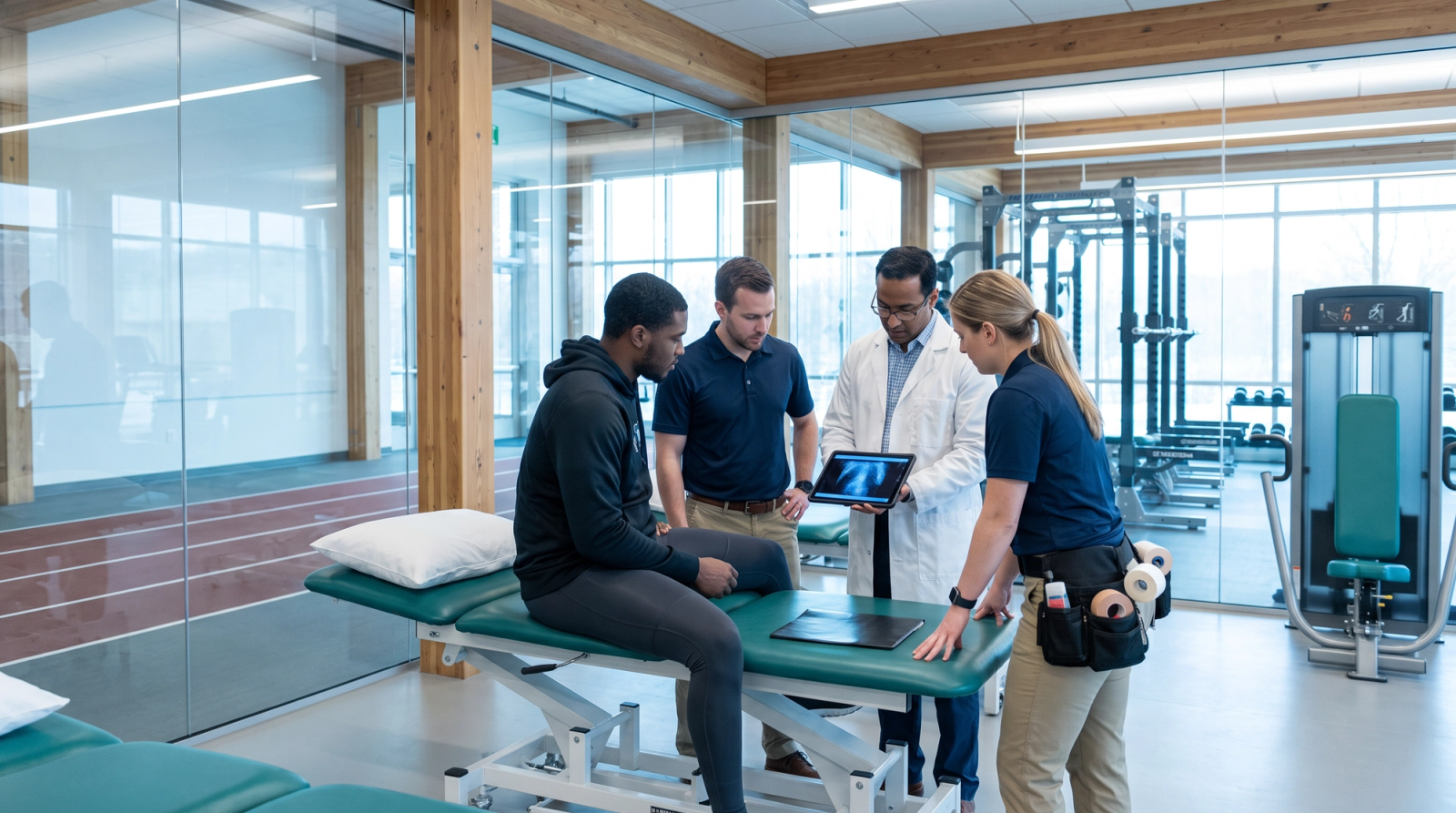
What sports medicine is, where it came from, the specialties that make it up, and the career paths within it, and how the whole system is supposed to work together.
Sports medicine is a broad, multidisciplinary field built around one goal: keeping active people moving safely, whether that means preventing an injury before it happens, treating one when it does, or guiding someone back to full performance afterward. This guide walks through where the field came from, the specialties that make it up, the career paths within it, and how it fits together as a system rather than a single job.
Most people encounter sports medicine at the moment they need it, a rolled ankle, a nagging shoulder, a concussion on the sideline, without ever seeing the structure behind it. That structure is worth understanding, because it explains why care for active people looks different from general medicine, and why it takes a team rather than a single provider to do well.
What Sports Medicine Is, at a Field Level
Sports medicine is the branch of healthcare focused on preventing, diagnosing, treating, and rehabilitating injuries connected to physical activity. It centers on the musculoskeletal system, bones, muscles, joints, tendons, and ligaments, and on the people who put that system under regular load (Cleveland Clinic).
It isn't limited to elite or professional athletes. The same principles apply to a teenager playing club soccer, an office worker training for their first marathon, or someone simply trying to stay active into their 60s and 70s. Sports medicine providers make a point of treating anyone whose injury or goal is tied to physical activity, athlete or not (Atlantic Health).
What separates sports medicine from general medicine is its orientation. The goal isn't just to treat a condition, it's to return someone to activity, and ideally to prevent the injury from happening again. That return-to-activity mindset shapes everything from how exams are conducted to how treatment plans are built.
A Brief History of the Field
Sports medicine as an organized discipline is relatively young. Team physicians, orthopedic surgeons, and athletic trainers spent much of the twentieth century treating athletic injury largely on an ad hoc basis, learning as they went, before the field consolidated into formal training and governance. The American Medical Society for Sports Medicine (AMSSM) was founded in 1991 to give primary care physicians practicing sports medicine a dedicated professional home, and its founding meeting drew about 120 physicians who felt the field lacked an organization built around their role (AMSSM).
Since then, the field has built out defined fellowship pathways and scopes of practice for physicians (AMSSM Scope of Practice), and expanded well past its original professional and collegiate footprint into hospital systems, academic medical centers, and increasingly, youth and amateur sports programs.
The Specialties That Make Up Sports Medicine
"Sports medicine" is really an umbrella over several distinct specialties, each contributing a different piece of care. A typical sports medicine program brings several of these together under one roof (Stanford Medicine Children's Health):
- Primary care sports medicine covers non-surgical diagnosis and management, handled by physicians who complete a sports medicine fellowship after training in family medicine, internal medicine, pediatrics, or emergency medicine
- Orthopedic sports medicine focuses on surgical treatment of structural injuries, like ACL tears or rotator cuff damage, performed by orthopedic surgeons
- Physical therapy rebuilds strength, mobility, and movement quality after an injury, surgery, or period of inactivity
- Athletic training provides on-site injury assessment, taping, emergency response, and return-to-play evaluation, most visible at practices and games
- Sports nutrition and sports psychology support performance, recovery, and mental resilience, particularly at competitive and professional levels
- Exercise physiology and biomechanics study how the body performs and adapts under load, informing training design and injury prevention programs
Each of these functions independently but is designed to hand off to the others as a case moves from prevention, to injury, to recovery, to performance.
What a Career in Sports Medicine Looks Like
Sports medicine offers several distinct career paths, not one linear track (AOSSM; UCLA Medical School):
- Sports medicine physicians complete a residency in a primary specialty, most often family medicine, internal medicine, pediatrics, or emergency medicine, followed by a one- to two-year sports medicine fellowship and a subspecialty certification exam
- Orthopedic surgeons specializing in sports medicine complete an orthopedic surgery residency, often followed by a sports medicine fellowship, and are trained to operate as well as manage injuries non-surgically
- Athletic trainers complete an accredited athletic training degree program and pass a national certification exam through the Board of Certification for the Athletic Trainer
- Physical therapists complete a Doctor of Physical Therapy (DPT) program, with some pursuing further sports-specialist certification
- Team physician and sideline roles, at the high school, collegiate, and professional level, are typically filled by physicians and athletic trainers working in coordination, split across in-clinic care and event coverage, rather than one role covering everything
Compensation and demand vary meaningfully by role and setting, from clinic-based primary care sports medicine to professional team positions, but the field overall has grown alongside rising participation in youth and amateur sports.
How These Roles Work Together in Practice
The clearest way to understand sports medicine as a field is to follow a single injury through it. A high school athlete sprains an ankle at practice. An athletic trainer evaluates it on the spot and decides whether play continues or the athlete needs further care. If it doesn't resolve, a sports medicine physician examines it, orders imaging if needed, and builds a treatment plan. If imaging reveals a structural tear that needs surgical repair, an orthopedic surgeon takes over that piece. A physical therapist then guides the rebuild of strength and mobility, and the athletic trainer signs off on the return-to-play decision once benchmarks are met.
No single person in that chain sees the whole picture unless the information moves cleanly between them. That coordination challenge is one of the more persistent, underdiscussed problems in the field. As we explore in Sports Medicine: What Do They Do?, understanding who's actually on that team is the first step to understanding how the handoffs between them are supposed to work, and where they tend to break down.
Why the Field Is Changing
Two forces are reshaping sports medicine right now. First, participation is broadening: more youth, amateur, and "weekend warrior" athletes are seeking the same level of structured care once reserved for professional sports. Second, data is becoming part of the clinical picture. Wearables, recovery tracking, and training-load data now sit alongside exam findings and imaging as inputs to return-to-play decisions, which is pushing the field toward better-connected tools rather than isolated specialists working from separate notes.
That second shift is the one we spend the most time on at Rivalists, building the connective layer between the physicians, physical therapists, and athletic trainers described above, so a case moves through the system with one shared picture of the athlete instead of a trail of disconnected updates.
The Bottom Line
Sports medicine isn't a single job, it's a coordinated field made up of physicians, surgeons, physical therapists, athletic trainers, and performance specialists, each trained for a specific piece of an athlete's health. Understanding the field at this level makes it much easier to navigate as a patient, a parent, or a provider, because it tells you not just what sports medicine is, but who to actually go to first.
The Rivalists team writes about the technology and practice of modern sports medicine. If you're a sports medicine provider looking to keep your care team's data in one place, we'd welcome a conversation about how Rivalists fits your workflow.
The Lifelong Athlete
Get the next one in your inbox.
Practical writing on athlete health, recovery, and AI-assisted performancecare — for providers and everday athletes. New articles directly to your inbox.